There’s something intoxicating about the Yamaha R6. It’s not just the roar, the lines, or the way it slices through corners. It’s the promise of speed—the type that doesn’t just register on a speedometer but runs through your spine. Exploring the Yamaha R6’s Top Speed is more than listing digits; it’s about understanding the mechanics, emotions, risks, and science behind what makes this supersport machine a living legend.
Understanding What “Top Speed” Really Means on a Yamaha R6
When riders talk about top speed, the assumption is that there’s a single definitive number. But here’s the truth: top speed is not static—it’s influenced by rider posture, road gradient, air density, gear ratios, wind resistance, and tuning.
With the Yamaha R6, most riders hit between 160 and 166 mph on an unrestricted, flat stretch with perfect conditions. But even reaching 150 mph on this machine is an experience that leaves a lasting imprint—something only those who’ve felt it can truly grasp.
But numbers aside, Exploring the Yamaha R6’s Top Speed requires peeling back layers that casual riders often overlook.
Aerodynamic Warfare: The R6 Is Built Like a Bullet
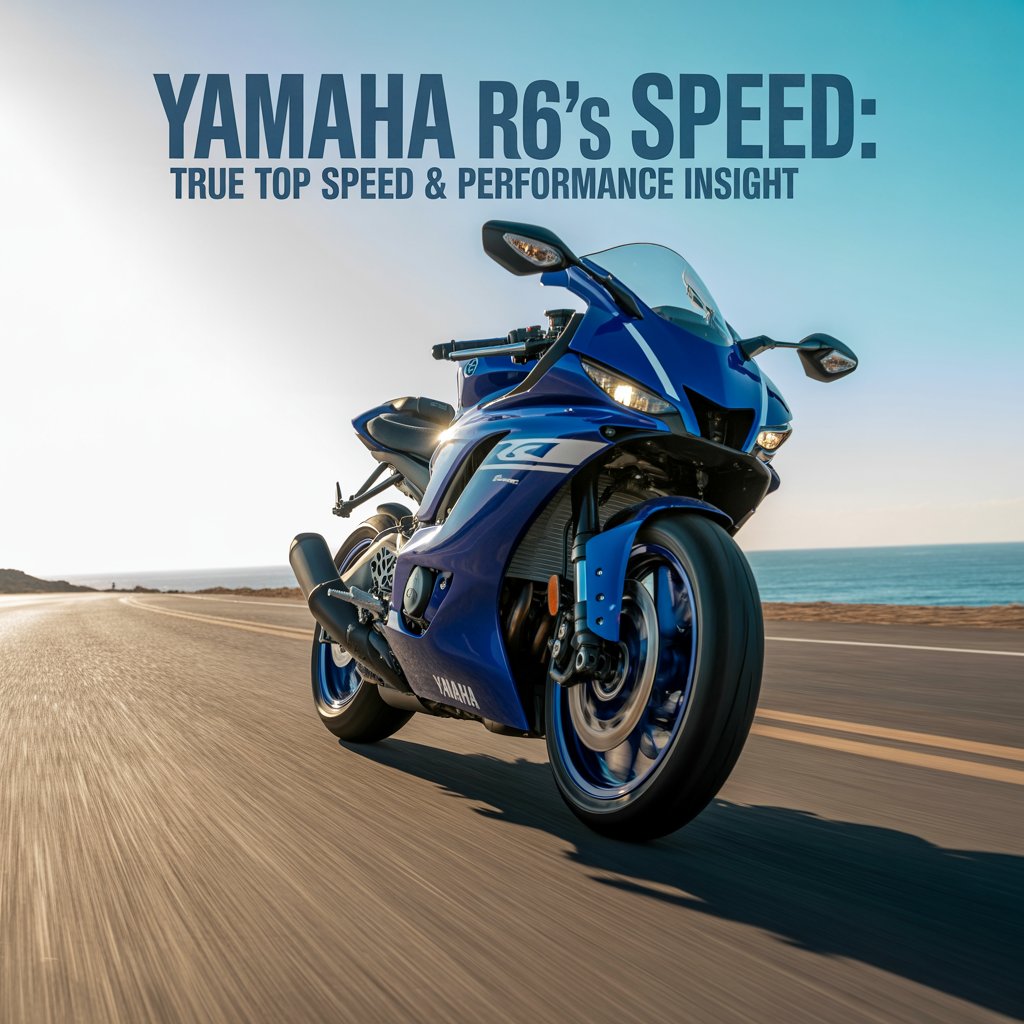
Aerodynamics are central to speed, and the R6 doesn’t mess around here. With a sharply tapered nose, race-inspired fairings, and a tail section designed to cut turbulence, every inch of this bike is about reducing drag.
The 2017+ models received subtle aerodynamic enhancements that help increase high-speed stability. But the real magic? It’s in the riding position. The R6 forces the rider into a forward lean, pressing their chest down into the tank—an aggressive stance not for comfort, but for slicing through the air like a missile.
When Exploring the Yamaha R6’s Top Speed, one learns fast: if you’re not tucked in like a MotoGP rider, you’re leaving 10–15 mph on the table.
The Heart of Speed: Inside the 599cc Inline-4 Engine
Let’s not sugarcoat it—the engine on the R6 is an angry, high-strung beast that begs to scream. Its redline is a jaw-dropping 16,500 rpm, and it doesn’t really come alive until you cross 8,000. Below that? It’s tame. Above that? It’s ballistic.
This engine produces around 120-123 horsepower at the crank, depending on the year. But peak horsepower isn’t everything. What matters is how that power is delivered. The R6 delivers power progressively, building intensity with a hair-raising crescendo that pulls harder the longer you hang on.
And here’s the kicker: Yamaha designed the R6 not for the quarter mile—but for the racetrack. That means gear ratios, throttle mapping, and ECU behavior all prioritize sustained high-RPM performance rather than drag-strip launches.
Top Speed Breakdown by Generation
Not all R6s are created equal. If we’re truly Exploring the Yamaha R6’s Top Speed, then each generation deserves its own look:
1999–2002 (Carbureted Models)
- Top Speed: ~155 mph
- Characteristics: Lightweight, nimble, aggressive in the corners
- Limitation: Lacked fuel injection, making throttle response less precise at high speeds
2003–2005
- Top Speed: ~158 mph
- Key Upgrade: Fuel injection introduced, better power delivery
- Noteworthy: Still relatively light, favored for stunt riders
2006–2016
- Top Speed: ~162–165 mph
- Highlight: Ride-by-wire throttle, slipper clutch, improved chassis rigidity
- Verdict: Most refined pre-2020 generation for top-end performance
2017–2020
- Top Speed: ~165+ mph
- Additions: Traction control, ABS, aerodynamic tweaks, new suspension
- Strength: Best high-speed stability and electronics package
What Riders Actually Experience at 165 MPH
You can read specs all day, but nothing compares to real-world experience. Here’s what several Yamaha R6 owners shared when asked about hitting top speed:
“Above 150, everything goes silent inside your helmet. You’re not thinking about speed anymore. You’re thinking about focus, and one wrong move can end it all.”
— Ameer, R6 track rider, Arizona
“When I hit 163 mph on a flat airstrip, I realized this isn’t just a fast bike—it’s an engineering marvel. It was stable, precise, and frighteningly smooth.”
— Jasper, Florida
“I’ve ridden liters, but the R6’s top-end pull is hypnotic. It just keeps going. You expect it to level off, but it doesn’t—it thrives above 14K rpm.”
— Leo, UK-based road racer
When Exploring the Yamaha R6’s Top Speed, these human experiences add a dimension no spec sheet ever can.
The Role of Gearing and Mods
Did you know that just changing your sprockets can dramatically alter your R6’s top speed? Stock gearing is typically 16/45 (front/rear), which offers a balance between acceleration and top speed.
- Add a tooth at the front sprocket? Slightly higher top speed, slower acceleration.
- Drop teeth in the rear? You may gain 5–7 mph, but lose the aggressive launch feel.
Also, ECU flash tuning, removing the top-speed limiter, and switching to a full-system exhaust can increase the R6’s top end by up to 8–10 mph, depending on mods and mapping.
Remember, though: at these speeds, it’s not just about “going faster”—it’s about how well your machine survives it. Tuning improperly can overheat your engine or cause instability at high revs.
Why the R6 Handles High Speed Better Than Many Liter Bikes
You’d think a 600cc can’t compete with a 1000cc in top speed. And while R1s and S1000RRs clearly have the edge, many riders prefer the R6 at high speed on tracks. Why?
- Lightweight Build: Easier to flick, correct mid-corner, and stay stable
- Predictable Throttle Response: No sudden surges—just linear power
- Chassis Tuning: The R6 chassis is a masterpiece of balance
- Mental Control: Riders say they feel more “in sync” with an R6 at 150+ mph than a liter bike with abrupt torque curves
So yes, while you’ll see higher top speed numbers on 1000cc bikes, Exploring the Yamaha R6’s Top Speed is about usable speed—not theoretical digits.
Track Days: The Only Legal Playground for Full Speed
You can’t ignore the legal and safety side. Public roads are no place for triple-digit exploration. Track days, on the other hand, are purpose-built for this.
At circuits like Buttonwillow, Road Atlanta, or Phillip Island, riders can fully open up the R6’s throttle without the fear of traffic, potholes, or law enforcement.
What’s more, racetracks have:
- Run-off zones
- Professional marshals
- Medical staff
- Coaching sessions to help you manage speed
Want to responsibly experience what 165 mph feels like? Get track tires, sign up for a beginner track day, and brace yourself for the most exhilarating day of your riding life.
Final Thoughts: Why R6’s Top Speed Still Matters Today
Even after Yamaha discontinued the street-legal R6, the bike didn’t lose its relevance. In fact, it became more coveted. Here’s why Exploring the Yamaha R6’s Top Speed still fascinates thousands:
- It’s a benchmark: Every rider wants to know how the R6 compares to other 600s. Spoiler: it usually wins.
- It teaches control: Mastering high-speed control on an R6 teaches skills that transfer to bigger bikes.
- It’s a visceral experience: Few machines allow such a precise, connected feeling between man and machine.
It’s not just about how fast it goes—it’s about how it gets there. The R6 doesn’t just hit high speeds; it earns them, and in doing so, gives you an experience that’s hard to rival.
Conclusion
Exploring the Yamaha R6’s Top Speed isn’t just about breaking 160 mph—it’s about understanding what makes the R6 a phenomenon in motorcycle history. It’s about aerodynamic design, throttle response, gearing intelligence, and real-world courage. From tucked-in corners on a racetrack to modded airstrip runs, every element of the R6 is built for speed—refined, responsive, and relentless.
If speed is a language, the Yamaha R6 is fluent in it—and it speaks with a scream that echoes far beyond the redline.