Introduction: Treat Your Scooter Like a Machine, Not Magic
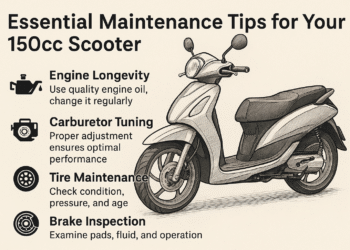
A gas scooter might look like a simple machine, but underneath that sleek frame is a finely-tuned combination of combustion engineering, torque transfer, electrical circuits, and high-speed rotation. Many riders treat their scooter like a plug-and-play device—fuel it, twist the throttle, and expect it to perform flawlessly. But like any machine with moving parts, Maintenance Tips for Your Gas Scooter aren’t just optional—they’re survival tactics for your vehicle.
In this no-nonsense guide, we dig deep into every inch of your scooter—from overlooked bolts to carburetor airflow ratios—to help you ride longer, safer, and smarter.
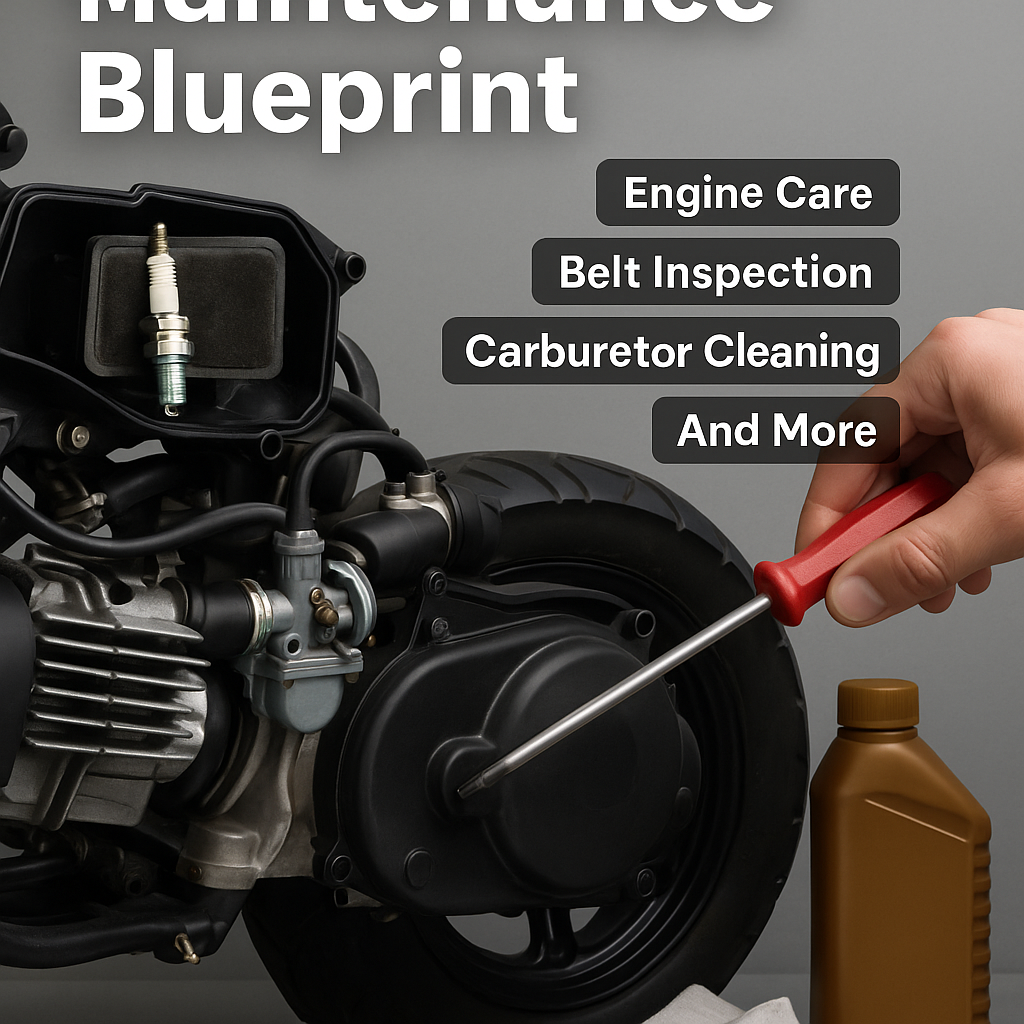
1. Understanding the Scooter’s Mechanical DNA
Before you even touch a wrench, understand your scooter’s blueprint.
- Engine Type: Most gas scooters use 2-stroke or 4-stroke engines. Each requires different oil types and intervals for servicing.
- Transmission System: CVT (Continuously Variable Transmission) is the standard. It requires belt tension checks and pulley inspection.
- Electrical Support: A compact battery powers the ignition, lights, horn, and indicators.
Knowing these basics helps you appreciate why proper servicing isn’t just about oil—it’s a mechanical ecosystem.
2. The 1,000 KM Rule: Build Your Core Maintenance Rhythm
Your first 1,000 kilometers set the tone. Here’s how:
- Engine Break-in: Avoid high RPMs. Let the piston rings seat properly.
- First Oil Change: At around 300 km, change the factory oil—metal shavings from break-in contaminate it.
- Bolt Torque Check: Factory-assembled bolts loosen slightly after heat expansion cycles. Re-torque critical points.
These foundational Maintenance Tips for Your Gas Scooter create a routine that prevents future breakdowns.
3. Carburetor Intelligence: Not Just Fuel, It’s Behavior
Your carburetor is a psychologist for your scooter—it studies air pressure, fuel demand, and rider throttle input.
- Symptoms of a Dirty Carb: Hesitation when accelerating, irregular idling, black smoke, and decreased mileage.
- Cleaning Technique (DIY):
- Remove carburetor and disassemble.
- Soak parts in a carburetor cleaning solvent.
- Use compressed air to unclog jets.
- Reassemble using a carb kit (replace gaskets and needle valves).
Keep this component in check, and you’ll feel like your scooter’s IQ just increased.
4. Oil Is the Blood: Change It Like You Care
Every combustion engine creates heat and metal wear. Oil isn’t just a lubricant—it’s a cooling agent and debris carrier.
- Ideal Oil Type: SAE 10W-40 for 4-stroke, pre-mix 2T oil for 2-stroke.
- Change Frequency: Every 800–1,200 km.
- Oil Filter: Replace or clean mesh screens if equipped.
One of the cornerstone Maintenance Tips for Your Gas Scooter is this: Neglected oil equals a dead engine.
5. Drive Belt & CVT Case Inspection: The Hidden Workhorse
Your CVT (Continuously Variable Transmission) belt transfers engine power to your rear wheel. A worn belt can snap at 60 km/h—and that’s a crash waiting to happen.
- Inspection Signs:
- Cracks on belt surface
- Frayed edges
- Jerky acceleration
- Maintenance Tip:
Open the CVT case every 3,000 km. Replace belts every 6,000–8,000 km even if they “look fine.”
6. Tire Integrity: Contact Patches That Save Lives
Gas scooters are light, but even then, a flat tire at 40 mph can be lethal.
- Checkpoints:
- Tire Pressure: Weekly. Use a digital gauge.
- Tread Depth: Minimum 1.6 mm. Use a depth gauge or the penny test.
- Cracks/Bulges: Indicates dry rot or internal damage. Replace immediately.
Tires are your only contact with the road. Among all Maintenance Tips for Your Gas Scooter, this one may literally save your life.
7. Spark Plug Precision: Small Part, Giant Role
The spark plug ignites the fuel-air mixture. A faulty plug can reduce power, affect mileage, and cause hard starts.
- Inspection Frequency: Every 1,500 km.
- Signs of Wear:
- Black soot: Too rich.
- White tip: Too lean.
- Rusty tip: Water intrusion.
- Gap Setting: Use a feeler gauge. Most scooters require 0.6–0.7 mm gap.
Use OEM spark plugs—cheaper options wear faster and can damage the ignition coil.
8. Air Filter Hygiene: Let It Breathe
A scooter gas engine needs a precise mix of fuel and air. A clogged air filter causes rich mixtures, fouled plugs, and loss of power.
- Foam Filters: Clean with warm soapy water, then re-oil.
- Paper Filters: Replace every 2,000–3,000 km.
- Mesh Filters (aftermarket): Clean with compressed air.
One of the simplest yet most effective Maintenance Tips for Your Gas Scooter is keeping this component in check.
9. Brake System: Pressure, Pads, and Precision
Scooter brakes are small but critical. Check both front (usually disc) and rear (usually drum).
- Hydraulic Disc Brakes:
- Fluid: Replace every year.
- Pads: Replace if under 2.5 mm thickness.
- Drum Brakes:
- Adjust cable tension.
- Clean dust every 3,000 km.
Don’t wait for that loud screech. Brakes should stop you silently and instantly.
10. Electrical Diagnostics: Don’t Ignore the Buzz
From horn to headlamp, all electric functions depend on a healthy 12V battery.
- Charging Voltage (while engine runs): 13.5–14.5V
- Maintenance Checklist:
- Clean terminals
- Use dielectric grease
- Check wiring harnesses for fraying
If your headlight dims when you hit the brakes, your battery is waving a red flag.
11. Rust Prevention: Fight the Invisible Enemy
Rust doesn’t just attack your scooter’s beauty—it eats into structural integrity.
- What to Do:
- Apply silicone spray to metal joints.
- Use chain wax to coat the drive system.
- After a wash, dry every part with a microfiber cloth.
One of the unspoken Maintenance Tips for Your Gas Scooter is to always treat moisture as your enemy.
12. Long-Term Storage: Hibernation the Smart Way
Leaving your scooter unused for a few months? Then do it right.
- Checklist Before Storage:
- Empty the fuel tank or use stabilizer
- Inflate tires to max pressure
- Disconnect the battery and keep it on trickle charge
- Cover with a breathable scooter tarp
When spring arrives, your scooter will roar back to life instead of coughing out rust.
13. Chain Maintenance (For Chain-Driven Models)
Chain tension affects throttle response. Too tight = stress on transmission. Too loose = risk of dislodgement.
- Steps:
- Clean with kerosene and a brush
- Apply chain lube
- Adjust slack to 20–30 mm
Check every 500 km, especially if riding in dusty or rainy environments.
14. Handlebar & Steering Column: Feel the Flow
Many riders forget to check their handlebar integrity—until steering starts to “stick.”
- Maintenance Actions:
- Check for loose nuts on steering column
- Lubricate the front fork bearings
- Tighten grip screws
A tight handlebar can tire your arms and reduce reaction time during emergencies.
15. Final Checklist: What the Pros Don’t Tell You
Here are bonus Maintenance Tips for Your Gas Scooter that even some workshops skip:
- Kill Switch Functionality: Often ignored but can save your engine in emergencies.
- Throttle Cable Lubrication: Prevents stiffness and sticking.
- Exhaust Port Check: Carbon buildup reduces power. Clean every 5,000 km.
- Mirror Tightness: A loose mirror mid-ride can be deadly.
Conclusion: Don’t Just Ride—Understand, Maintain, Respect
Your gas scooter is more than just a convenient ride. It’s a complex system of moving parts, chemistry, physics, and timing. By following these in-depth Maintenance Tips for Your Gas Scooter, you not only increase its lifespan—you elevate your riding experience.
Riders who maintain their scooters properly don’t just save money—they ride with pride, reliability, and peace of mind. So treat your scooter like a living machine, and it will never let you down.