Introduction: Scooters Are Machines With Habits
Most people treat scooters like toasters — push the button and expect them to work. But your 150cc scooter is far from that. It’s a tightly engineered machine that thrives on habits. Miss those habits — skip a tiny check, ignore a strange noise, or ride one more day on bad tires — and it starts breaking down.
This isn’t your average blog post filled with generic “check tire pressure” tips. This is a real-world, in-depth toolkit of maintenance tips for your 150cc scooter that cover how your machine breathes, moves, stops, cools, vibrates, and even ages.
Let’s build the ultimate scooter care manual — not just to save money, but to understand how to master your machine.
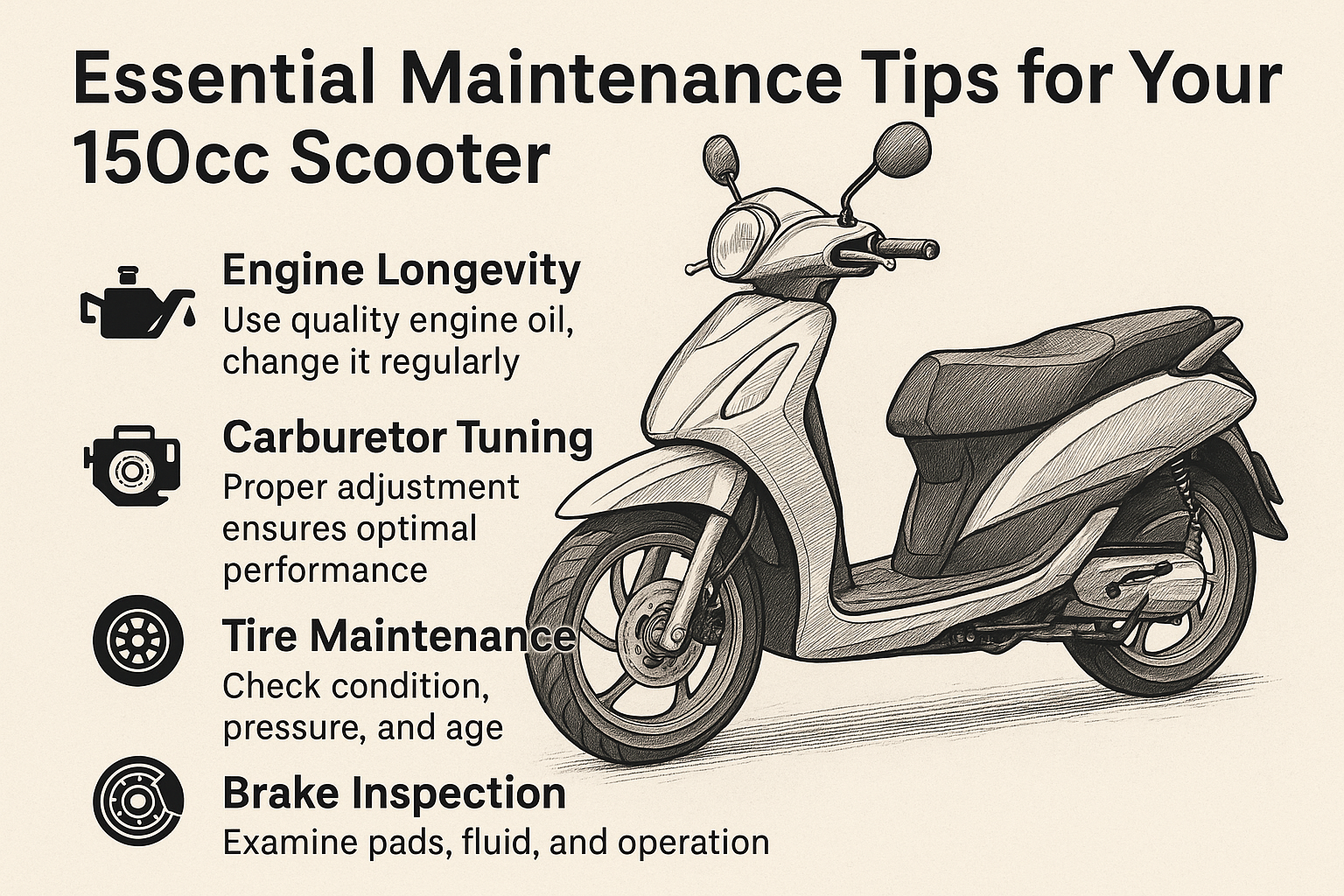
1. Engine Longevity Starts with Internal Cleanliness
Your scooter’s engine is a high-heat, fast-moving zone. And yet, most people dump the cheapest oil into it or forget about it for months. Here’s the reality:
- A 150cc engine runs at 8,000–9,000 RPM on average.
- At those speeds, cheap or dirty oil can destroy piston rings, valves, and cylinder walls.
- Heat, friction, and microscopic debris are always trying to wear down internal parts.
Action Plan:
- Use semi-synthetic 10W-30 or 10W-40 engine oil made for two-wheelers. Stick to brands like Motul, Liqui Moly, or Castrol Power1.
- Replace oil every 1200 km (not 3000 km, that’s outdated advice).
- Always warm up the engine for 2–3 minutes before changing oil so it drains fully.
- Clean the oil strainer screen — most people miss this.
Among all maintenance tips for your 150cc scooter, oil quality and change timing have the most direct effect on engine lifespan.
2. Carburetor Tuning: Your Hidden Fuel Master
While FI (Fuel Injection) scooters are gaining popularity, most 150cc scooters still run on carburetors. A poorly tuned carburetor is like trying to sprint while breathing through a straw.
Real Signs of Carb Issues:
- Jerky acceleration
- Rough idling
- Sudden engine cut-offs at low speed
- Choking when throttle is opened
Pro-Level Tip:
- Adjust the air-fuel screw (usually located on the carb body). Start by turning it fully in (clockwise), then unscrew it 1.5 turns for a base setting.
- Clean the main jet and idle jet every 2000–3000 km — tiny debris can choke fuel supply.
Maintenance tips for your 150cc scooter that skip carb tuning are incomplete — this part controls both mileage and pickup.
3. Tires Are Not Just Rubber — They’re Your Foundation
Tires aren’t just circles of rubber; they’re your only contact with the earth. Poor tire health kills fuel economy, handling, and braking.
Uncommon but Critical Insights:
- Check sidewall date codes — if your tires are older than 3 years, replace them, even if tread is fine.
- Always measure pressure when tires are cold — warm tires expand and give a false reading.
- Use nitrogen instead of air if available — it keeps pressure stable longer and reduces moisture damage inside.
This isn’t a small thing. One of the most underrated maintenance tips for your 150cc scooter is to rotate front and rear tires every 4,000 km. Yes, scooters need rotation too — especially when both tires are the same size.
4. Brakes: Maintenance You Feel in Your Bones
You don’t need a mechanic to check your brakes — your own hand pressure and ear are enough.
Advanced Tips:
- Disc brake? Spin the wheel manually and pump the brake — feel for “sponge” in the lever. If the bite is late or weak, bleed the brake fluid and top it with DOT 3 or DOT 4 fluid.
- Drum brake? Use your hand to measure lever travel. If it goes more than 2 inches, tighten the cable adjuster near the lever.
- Check brake shoe dust — too much buildup can squeal even with good brakes.
Brake pads have a life of about 6,000 km, but riding style can cut it in half. Brakes are not just about stopping — they control cornering, momentum, and confidence.
5. The Ignition System: Sparks Define Performance
The spark plug isn’t just a tiny screw-like device. It’s the pulse of your engine. Misfires, hesitation, and sluggish pickup all start here.
Golden Maintenance Routine:
- Remove and inspect your spark plug every 2000 km.
- Look for color:
- Tan = Perfect combustion
- Black = Rich fuel mix (clean your air filter)
- White = Lean mix or overheating
Use an NGK Iridium spark plug for better throttle response. It costs more but lasts 3x longer and gives cleaner, more efficient ignition.
6. Transmission & Belt Maintenance = Smooth Power
The CVT system (Continuously Variable Transmission) in your scooter isn’t like a car’s gearbox. It uses a belt + roller system to vary gear ratio.
What to Do:
- Clean the CVT housing every 4000 km.
- Inspect belt thickness — if it’s below 18 mm, it’s time to replace.
- Upgrade to Kevlar belts if you ride aggressively — they last longer and handle heat better.
You’ll feel the difference in smoothness instantly. One of the most practical maintenance tips for your 150cc scooter is inspecting roller weights — heavier rollers give higher top speed, lighter ones improve acceleration.
7. Cooling System: Air or Liquid, It Needs Attention
Most 150cc scooters are air-cooled, but a few have liquid cooling. Either way, heat management is key.
Tips for Both Systems:
- For air-cooled scooters, clean the fins with a soft brush during oil changes.
- For liquid-cooled models:
- Top up coolant once a month.
- Flush and replace coolant every 12 months — use silicate-free coolant only.
- Inspect radiator fans and thermostat function during service.
Heat damage builds silently. Warped pistons, hardened valve seals, and oil thinning all begin with poor heat dissipation.
8. The Final Shield: Rust, Dirt, and Weather Protection
Your scooter lives outside — it faces rain, dust, sun, and moisture daily. A lot of long-term damage begins with environmental exposure.
Protection Tips That Most Riders Miss:
- Spray WD-40 or silicone lubricant on bolts, exhaust mounts, and stands every month.
- Clean inside the under-seat compartment — moisture gathers here, especially near the battery.
- After rain, dry the brake levers and throttle area thoroughly. Water inside the throttle cable can freeze or corrode.
- Use a breathable cover — not just plastic sheeting. Trapped moisture rusts metal faster.
Protecting your scooter’s frame is just as important as maintaining the engine. Among the smartest maintenance tips for your 150cc scooter is spending just 15 minutes every week giving your scooter a post-ride wipe down.
Conclusion: A Scooter That Serves, Only If You Serve It First
Think of your 150cc scooter like a living machine — it responds directly to the attention you give it. Neglect shows up in performance, breakdowns, and fuel bills. But care? Care returns tenfold — in smoother rides, lower costs, and years of loyal service.
These maintenance tips for your 150cc scooter aren’t just about making it run. They’re about making it thrive — keeping it fresh, sharp, and safe mile after mile.
Because real riders don’t just ride — they maintain. And now you know exactly how.